Burgundy Wine, Explained Simply
Burgundy is the world's most imitated wine region and its most complex. Understanding it takes an afternoon. Finding the right bottle takes a lifetime. Here's where to start.
- Two grapes only: Pinot Noir for reds (concentrated in the Côte de Nuits), Chardonnay for whites (Côte de Beaune and Chablis). No blending, no exceptions at the quality level.
- The hierarchy runs bottom to top: Bourgogne Régionale, Village, Premier Cru, Grand Cru. But a village wine from a great grower will beat a Grand Cru from a lazy one.
- In Burgundy, the producer (domaine) matters as much as the appellation. Two estates 200m apart farming the same vineyard can produce wines that taste completely different.
- Good village-level Burgundy exists under CHF 50. It requires knowing which producers to trust — the label alone won't tell you enough.
Every serious wine region in the world has been trying to replicate Burgundy for two centuries. California's best Chardonnay and Pinot Noir estates are explicit attempts. New Zealand's Central Otago and Oregon's Willamette Valley were founded on the premise. Even Etna, in Sicily, gets called 'the Burgundy of southern Italy.' The imitation is not flattery so much as acknowledgement: Burgundy does something with those two grapes, in that specific strip of land, that no one else has quite managed to reproduce.
Understanding why requires understanding terroir — the French concept that the taste of a wine is shaped by where and how it was grown. Burgundy is where the idea was born and where it is most clearly demonstrated.
Where Burgundy is
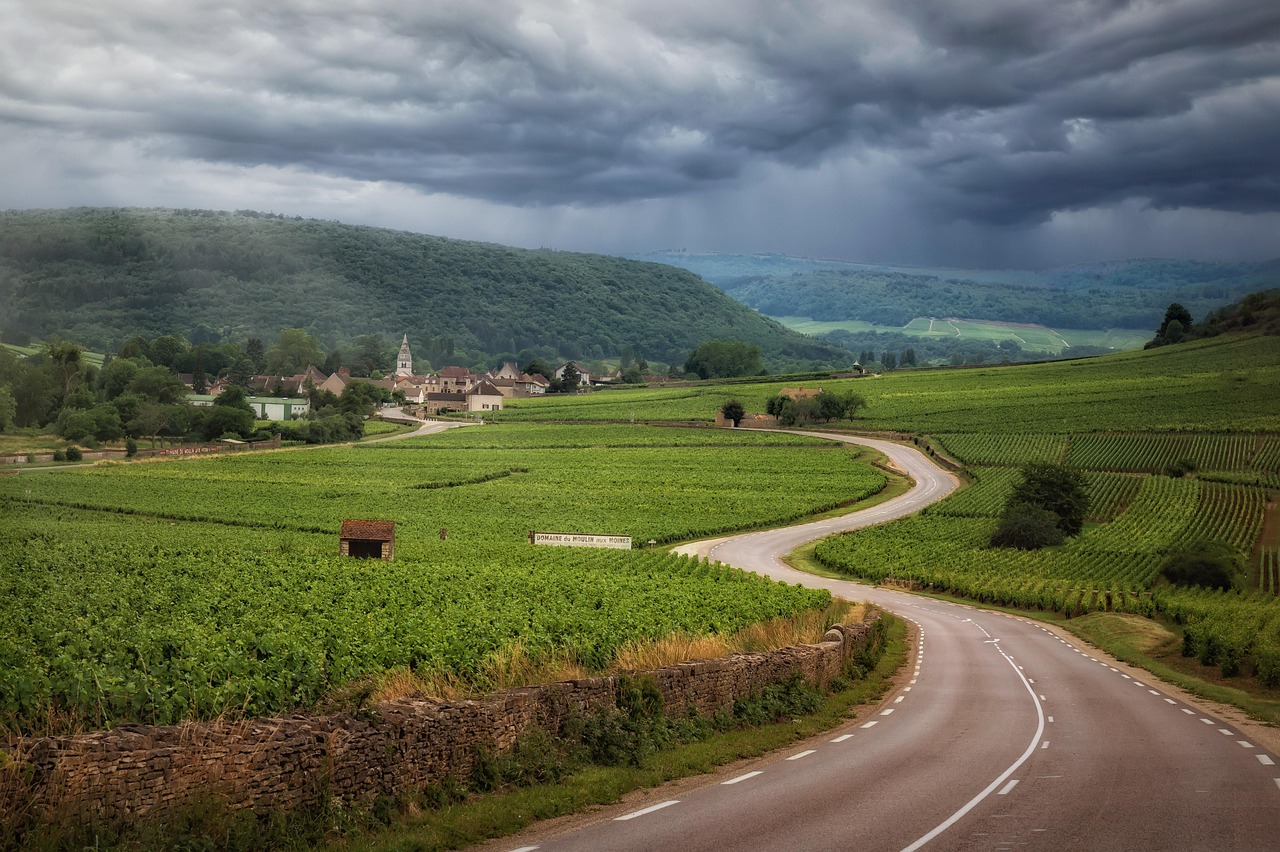
Burgundy (Bourgogne in French) runs north to south through a narrow corridor in central-eastern France, roughly from Dijon in the north to Mâcon in the south. The most valuable vineyards — the Côte d'Or — occupy a slope of Jurassic limestone about 50km long and rarely more than 2km wide. Facing southeast, they catch morning sun but are protected from afternoon heat; the limestone subsoil drains freely but holds moisture at depth. It's an almost accidental combination of factors, and it took centuries of monastic viticulture to identify which small plots within that slope produced something extraordinary.
Côte de Nuits and Côte de Beaune
The Côte d'Or divides into two sections. The northern half — the Côte de Nuits, running south from Dijon through Gevrey-Chambertin, Chambolle-Musigny, Vougeot, Vosne-Romanée, and Nuits-Saint-Georges — is almost entirely red wine country. The Pinot Noirs here have the deepest colour, the most complex structure, and the greatest ageing potential in the appellation.
The southern half — the Côte de Beaune, running from Aloxe-Corton through Beaune, Pommard, Volnay, and ending at Chassagne-Montrachet and Santenay — produces both reds and whites. The great white Burgundies (Meursault, Puligny-Montrachet, Chassagne-Montrachet) are Côte de Beaune wines. The reds here tend toward elegance and earlier approachability compared to the Côte de Nuits.
Further north, Chablis sits as a distinct outpost — cool, northerly, planted on Kimmeridgian limestone that gives the Chardonnay its characteristic flinty, mineral, almost oyster-shell quality. Chablis is the most accessible entry point into white Burgundy.
The four tiers explained
Burgundy's appellation hierarchy reflects centuries of observation about which land produces the best wine. It runs from broad to specific, and from cheapest to most expensive.
Bourgogne Régionale covers the entire region. A bottle labelled simply 'Bourgogne Pinot Noir' or 'Bourgogne Chardonnay' can use grapes from anywhere in Burgundy. Entry point for the style; very variable quality.
Village wines are labelled with the name of the commune — 'Gevrey-Chambertin', 'Meursault', 'Chambolle-Musigny'. The fruit comes entirely from that village's appellation. This is where Burgundy starts to show its character, and where the producer matters enormously.
Premier Cru vineyards are the best-classified plots within a village. The vineyard name appears on the label (e.g. 'Gevrey-Chambertin Lavaux Saint-Jacques Premier Cru'). There are about 640 Premier Cru vineyards in Burgundy.
Grand Cru is the apex — 33 vineyards across the Côte d'Or that are classified as producing the finest wine in Burgundy. They have their own appellation: the wine is labelled 'Chambertin', not 'Gevrey-Chambertin Chambertin'. Grand Cru covers less than 2% of Burgundy's total production.
Why the producer matters so much
A Clos de Vougeot (a 50-hectare Grand Cru vineyard) is owned by about 80 different producers. Two bottles from the same vineyard, the same vintage, can taste entirely different — one elegant and precise, one rough and rustic — depending entirely on the farming, the winemaking decisions, and the quality standards of the domaine. This is what makes Burgundy so frustrating and so fascinating: you need to know not just where the wine is from, but who made it.
A reliable village wine from a serious producer (Rossignol-Trapet, Mugnier, Dujac, Armand Rousseau, Nicolas Potel, Simon Bize) will consistently outperform an uninspired Premier Cru from a larger, less careful operation. Buying Burgundy without knowing the producer is like buying a restaurant meal without knowing who's in the kitchen.
Drinking windows
Village Burgundy: red at 5–10 years, white at 3–8 years. Drink with confidence; these are not wines built for extended cellaring. Premier Cru: red at 8–15 years (the great communes longer), white at 5–12 years. Grand Cru: the reds from Gevrey-Chambertin, Vosne-Romanée, and Chambolle-Musigny at their best need 15–25 years; the whites from Montrachet and Corton-Charlemagne at 10–20 years.
Chablis is the exception: Premier and Grand Cru Chablis age beautifully for 15–20 years, but even village Chablis rewards 3–5 years of patience.
How to find value
Three reliable strategies. First: village wines from great producers — a Chambolle-Musigny Village from Mugnier or a Meursault from Coche-Dury will always outperform their classification. Second: look south to the Mâconnais, where Chardonnay grown on similar limestone produces excellent wine at a third of Côte de Beaune prices (Pouilly-Fuissé, Saint-Véran, Viré-Clessé). Third: look north to Chablis — village Chablis from a serious producer (Raveneau, Dauvissat, William Fèvre) at CHF 25–40 is one of the best-value white wine purchases in France.
Looking for a Burgundy worth drinking? Tell our sommelier your budget and whether you want red or white — she'll find the right domaine.
Questions we get asked
What's the difference between Burgundy and Bordeaux?
Almost everything. Bordeaux is blend-based (Cabernet + Merlot), estate-focused, graded by château reputation, and built for consistent production at scale. Burgundy is single-variety (Pinot Noir or Chardonnay), producer-focused, graded by vineyard terroir, and produced in tiny quantities from hundreds of small domaines. Bordeaux rewards learning the classification; Burgundy rewards learning the producers.
Is all Burgundy expensive?
No, though the famous names are. A village Bourgogne Pinot Noir from a careful producer starts at CHF 20–30. Village appellation wines (Gevrey-Chambertin, Chambolle-Musigny, Meursault) from good domaines run CHF 40–80. Premier Crus start at CHF 80–120. Grand Crus and wines from the most famous domaines (Romanée-Conti, Rousseau, Leroy) are priced as luxury collectibles and are mostly allocated to long-standing customers.
How do I pronounce Burgundy wine names?
The most common mistakes: Gevrey-Chambertin (zhev-ray shahm-behr-TAN), Chambolle-Musigny (shahm-bohl moo-ZEE-nyee), Vosne-Romanée (vohn roh-mah-NAY), Meursault (mur-SOH), Puligny-Montrachet (poo-lee-nyee mohn-rah-SHAY). In a restaurant, a sommelier will understand even an imperfect approximation — the important thing is to know what you want.
When should I drink a village Burgundy?
Red village Burgundy is at its best between 5 and 10 years from the vintage. Before 5 years it can be tight and primary; after 12–15 years a village wine can start to fade. White village Burgundy is good from 3–8 years. The best way to know when: open a bottle at 5 years, note whether it's still closing up or starting to open, and adjust your expectations for the rest of the case.