Piedmont: Barolo & Barbaresco
Barolo is 'the king of Italian wines' — a phrase that gets repeated so often it loses meaning. Here's what it actually refers to, and why Piedmont deserves close attention beyond its most famous name.
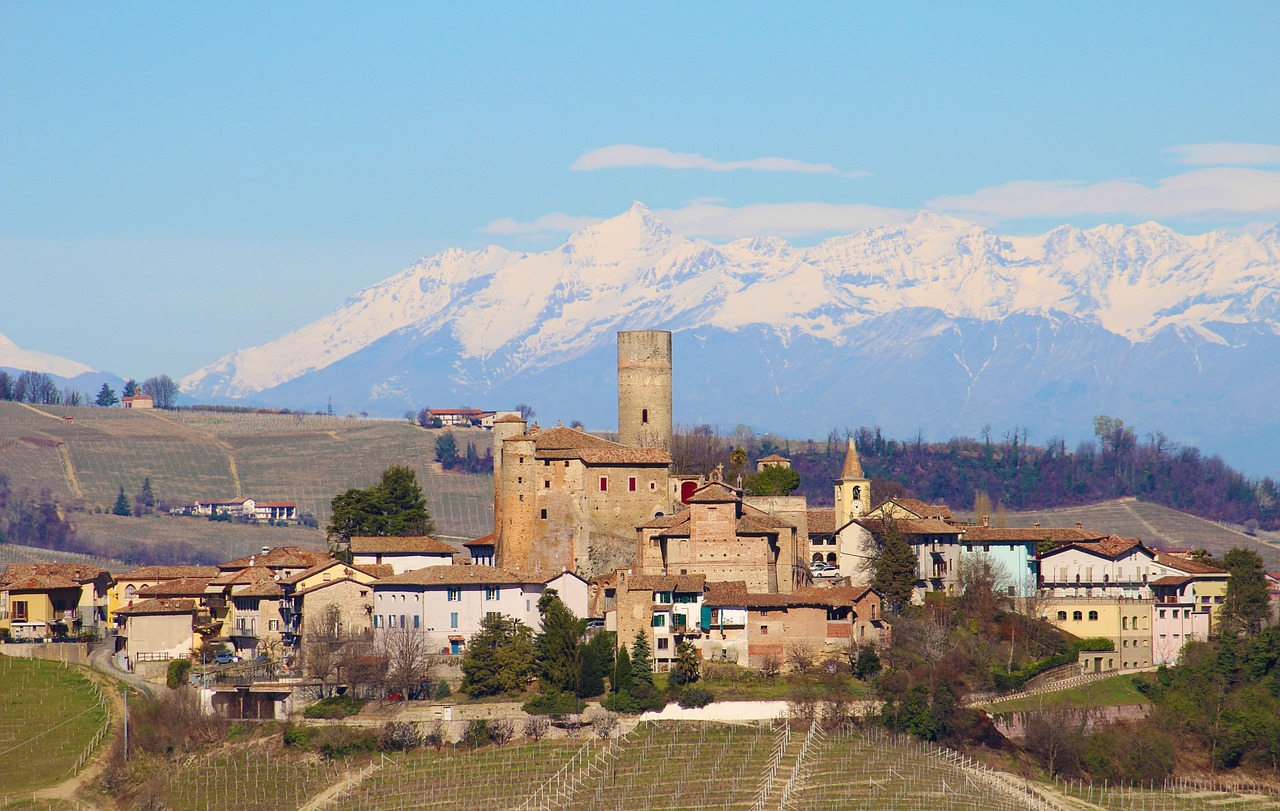
- Barolo and Barbaresco are both made from Nebbiolo — the same grape, grown in adjacent zones, with Barolo being the bigger, more tannic, longer-lived wine and Barbaresco the more accessible of the two.
- The village wines of the Langhe (Barolo from La Morra, Serralunga d'Alba, Castiglione Falletto) have distinct personalities driven by soil type — calcareous Helvetian marl produces elegant wines; Tortonian clay produces power.
- Barbera d'Asti and Dolcetto d'Alba are the everyday reds of Piedmont — lower tannin, higher acidity, and genuinely delicious at modest prices. They're what Piedmontese people drink on a Tuesday.
- The Langhe Nebbiolo DOC offers a 'baby Barolo' experience — Nebbiolo from outside the Barolo zone, earlier-drinking, accessible, and an ideal introduction to the grape.
Piedmont sits in the northwest corner of Italy, wedged between the Alps and the Apennines, and it produces what many consider Italy's greatest red wines. The claim rests primarily on Nebbiolo — a grape of severe beauty that demands patience in a way almost no other variety does. Young Barolo and Barbaresco are formidably tannic, closed, and difficult. Aged, they develop extraordinary complexity: tar and roses, dried violets, leather, dried cherries, truffle, and a finish that can last for minutes. The challenge is waiting for them to get there.
Nebbiolo: the grape of patience
Nebbiolo (named for the autumn fog — nebbia — that blankets the Langhe hills at harvest) ripens late and is sensitive to site in a way that rivals Pinot Noir. It needs slopes facing south or southwest to ripen fully; it needs clay soils for structure; it needs the specific limestone-marl geology of the Langhe to produce its distinctive aromatic profile. Transplant it outside Piedmont and you usually get something that is interesting but not quite right — as producers in California and Australia have discovered.
The variety produces high tannin, high acidity, and moderate colour — a counterintuitive combination. Young Nebbiolo can look almost brick-orange at the rim despite tasting powerfully astringent. With age, it develops that famous garnet-brick colour and the aromatic complexity that no other variety quite replicates.
Barolo: the king and its villages
The Barolo DOCG covers eleven communes south of Alba. The most important are La Morra, Barolo, Castiglione Falletto, Serralunga d'Alba, and Monforte d'Alba — and they produce meaningfully different wines.
La Morra and Barolo village sit on the older Tortonian soils (clay-rich, compact) — they produce wines that are more perfumed and approachable in youth, earlier to open. The celebrated Brunate vineyard sits here.
Serralunga d'Alba has the youngest, most compact Helvetian soils — wines from Serralunga are the most powerful, the most tannic, and the longest-lived. Giacomo Conterno's Monfortino — arguably Italy's most famous wine — comes from Serralunga.
The 2010 reform created Menzioni Geografiche Aggiuntive (MGAs) — individual vineyard classifications for Barolo and Barbaresco. The map of MGA sites now lists more than 170 vineyards. The most famous: Cannubi, Brunate, Bricco Rocche, Vigna Rionda, Sori San Lorenzo, Asili.
Barbaresco: Barolo's neighbour
Barbaresco is made from the same grape on similar soils a few kilometres northeast of Alba. By regulation, it requires slightly less ageing before release (minimum two years versus three for Barolo, four for Barolo Riserva). In practice, the wines are more elegant and approachable than Barolo, though the finest examples — from Gaja, Bruno Giacosa, Produttori del Barbaresco — are every bit as complex and age-worthy.
The Produttori del Barbaresco cooperative is one of Italy's great wine stories: a small grower cooperative producing village and vineyard-designated wines of exceptional quality at prices that seem impossibly modest given the quality. Buy their wines.
The everyday reds: Barbera and Dolcetto
Not every Piedmontese meal calls for Barolo. The region's everyday reds are Barbera d'Asti and Dolcetto d'Alba — both producing wine of genuine pleasure at accessible prices.
Barbera is high in acidity, low in tannin, and produces wines of vivid cherry-and-plum fruit with a characteristic tartness that makes them perfect with food. At modest prices, it's one of Italy's great food wines. At higher quality levels (Braida's Bricco dell'Uccellone), it can be genuinely impressive.
Dolcetto is softer and slightly bitter — dark fruit, liquorice, and a characteristic almond finish. It's best drunk young, chilled very slightly, with local salumi and pasta. The name means "little sweet one" but the wine is bone dry.
Moscato d'Asti
Piedmont also makes one of Italy's most beloved sweet wines — Moscato d'Asti: gently sparkling (frizzante), low in alcohol (around 5–6%), intensely aromatic, and sweet without being cloying. It's the ideal end to a long meal. Buy it young, drink it cold, and don't look for something complex — the simplicity is the point.
Ready to explore Piedmont? Tell the sommelier your budget and whether you want to drink it now or lay it down.
Questions we get asked
How long does Barolo need to age?
The legal minimum is 3 years from harvest (5 for Riserva). In practice, most Barolo from serious producers needs 8–12 years before it's drinking well — and the best wines from outstanding vintages (2010, 2013, 2015, 2016) will reward 20–30 years of patience. Opening a Barolo too early (under 7 years) usually means a wine that is tannic, closed, and not showing its best. If you want to drink Nebbiolo now, choose Langhe Nebbiolo or Barbaresco from an accessible producer.
What's the difference between Barolo and Barbaresco?
Both are 100% Nebbiolo from adjacent zones in the Langhe hills. Barolo (south of Alba) is generally bigger, more tannic, and longer-lived — it requires 3 years' minimum ageing. Barbaresco (northeast of Alba) tends toward slightly more elegance and earlier accessibility, with a 2-year minimum. The distinction is not absolute — some Barbarescos outlive some Barolos. Think of them as different expressions of the same great grape rather than a strict hierarchy.
What food pairs with Barolo?
Barolo's tannin demands substantial, fatty food: slow-braised beef (brasato al Barolo — actually cooked in the wine), roasted lamb, game (hare, venison, wild boar), fresh white truffle, aged Parmigiano-Reggiano. It's not a wine for delicate food — the tannin will overwhelm it. For lighter Piedmontese dishes (tajarin with butter, vitello tonnato), reach for Barbera or Dolcetto instead.
Is there good entry-level Piedmont wine?
Yes — Langhe Nebbiolo, Barbera d'Asti, Dolcetto d'Alba, and Moscato d'Asti all offer genuine Piedmont character at accessible prices. Produttori del Barbaresco's village Barbaresco is outstanding value. Giacomo Fenocchio's Dolcetto d'Alba is a staple. Braida makes the benchmark Barbera. And Langhe Nebbiolo from Prunotto or Vietti is an excellent introduction to the Nebbiolo grape without the Barolo price tag.