Tuscany: Chianti, Brunello & Super Tuscans
Tuscany is Italy's most recognised wine region — Chianti, Brunello, and the Super Tuscans cover the full range from everyday drinking to benchmark fine wine. Here's how to navigate all of it.
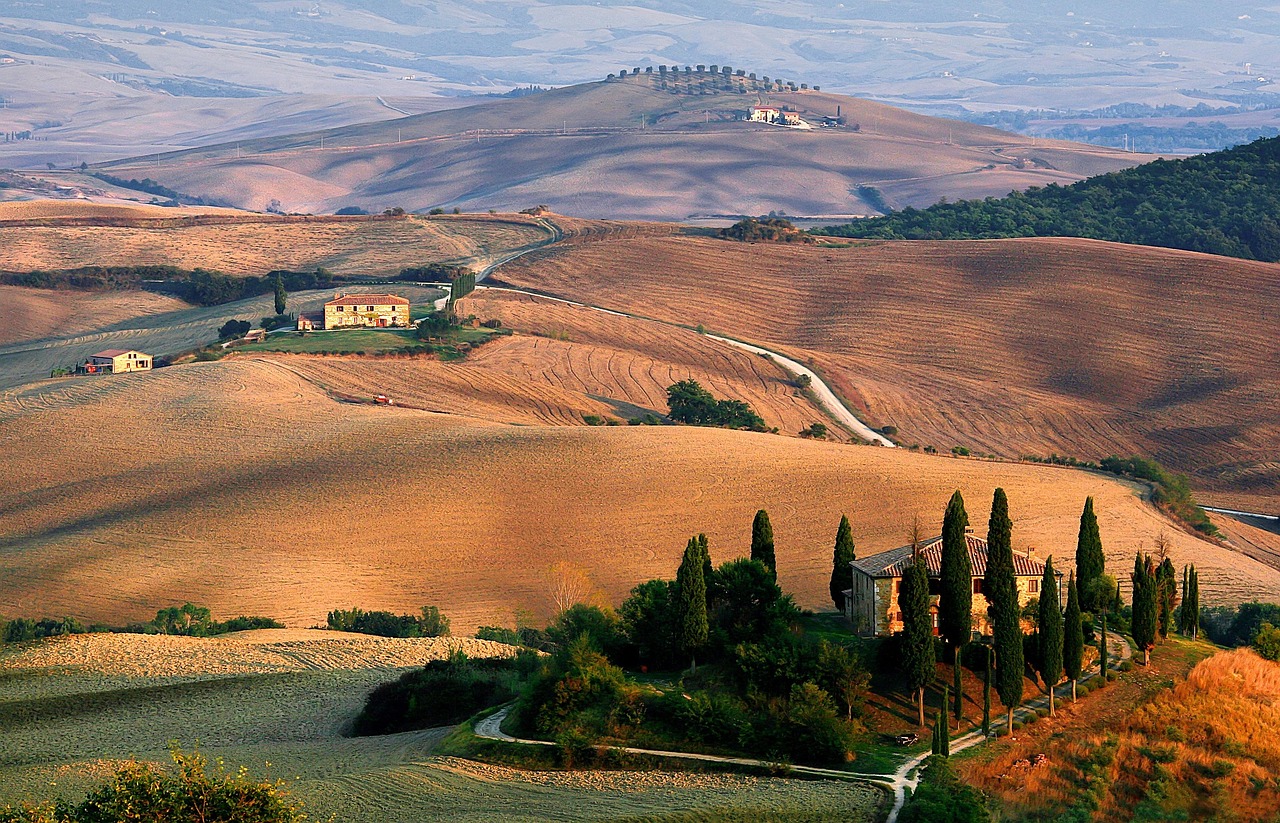
- Sangiovese is the backbone of Tuscany — it makes everything from basic Chianti to Brunello di Montalcino, one of Italy's longest-lived red wines. The same grape tastes radically different depending on site, clone, and winemaker.
- Chianti Classico (the historic zone between Florence and Siena) is meaningfully different from generic Chianti — look for the black rooster (Gallo Nero) logo on the neck label.
- Super Tuscans emerged in the 1970s when producers blended Cabernet Sauvignon or Merlot with Sangiovese outside DOC rules — they were initially classified as humble table wine. Some now cost thousands per bottle.
- Brunello di Montalcino must be aged at least five years before release (six for Riserva) — it's one of the most strictly regulated wines in Italy and one of the longest-lived.
Tuscany has the advantage of having become the world's reference for Italian wine at a moment when Italian wine was being taken seriously for the first time. Chianti's bottle in its straw basket (the fiasco) was everywhere in the 1970s — cheap, cheerful, and usually not very good. What happened next is one of wine's great rehabilitation stories: a generation of ambitious producers rewrote the rules, planted international varieties alongside Sangiovese, and turned Tuscany into a region capable of making wines that could stand alongside the finest in the world.
Sangiovese: one grape, many faces
Virtually all of Tuscany's great reds are built on Sangiovese — a grape of extraordinary versatility and frustrating variability. In cool, high-altitude Montalcino, it produces the Brunello clone: dense, tannic, capable of 30–40 years of ageing. In the Chianti hills, it makes lighter, more fragrant, cherry-and-herb wines for earlier drinking. In Montepulciano (as Prugnolo Gentile), it's somewhere between the two. The same variety; radically different results depending on elevation, soil, and clonal selection.
Chianti and Chianti Classico
Generic Chianti covers a vast area of Tuscany and ranges from thin industrial wine to solid everyday drinking. The classification you want is Chianti Classico — the original, historic zone between Florence and Siena, identifiable by the black rooster (Gallo Nero) neck label. Within Chianti Classico, the hierarchy runs: base Chianti Classico, Chianti Classico Riserva (at least two years' ageing), and Gran Selezione (minimum 30 months, single-vineyard or selected lots).
The best Chianti Classico producers — Badia a Coltibuono, Fontodi, Castell'in Villa, Fèlsina, Monte Vertine — make wines of genuine complexity at prices that remain reasonable relative to comparable quality from Burgundy or Napa. A Chianti Classico Riserva from a good producer at eight to twelve years old is one of Tuscany's most reliable pleasures.
Brunello di Montalcino
Brunello is the Italian red that gets closest to what Burgundy does with Pinot Noir — a single variety on a single hill, producing wines of almost infinite complexity. The Montalcino hill, south of Siena, has the warmest and driest climate in Tuscany, which allows Sangiovese Grosso (Brunello) to ripen fully while retaining the acidity it needs to age.
Minimum ageing: 5 years from harvest before release (6 for Riserva). In great vintages (2010, 2012, 2015, 2016), the best Brunellos — Giacomo Conterno's Monfortino-equivalent, Biondi-Santi, Casanova di Neri, Poggio di Sotto — can age 30–50 years. Entry-level Brunello from good producers in good vintages is typically CHF 60–100. It is worth every franc.
Rosso di Montalcino is the "baby Brunello" — the same vineyards and winemaking team, released younger, at a fraction of the price. An excellent introduction to the Montalcino style.
The Super Tuscans
In the 1970s and 1980s, a group of producers led by Antinori (with Tignanello), Sassicaia, and Ornellaia began blending Cabernet Sauvignon and Merlot into their wines — varieties not permitted under Chianti DOC rules. Rather than fight the bureaucracy, they declassified their wines to humble Vino da Tavola (table wine). Paradoxically, these "table wines" became some of Italy's most expensive.
The IGT Toscana designation was eventually created to accommodate them. Today, the term Super Tuscan covers a broad range: from Sassicaia and Ornellaia (CHF 150–300+) down to blends that use the prestige of the category to charge premium prices for ordinary wine. The category has real highs and genuine cynical bottoms — producer reputation matters more here than classification.
Vino Nobile di Montepulciano
Often overshadowed by Brunello and Chianti, Vino Nobile is Tuscany's third great DOCG — Prugnolo Gentile (a Sangiovese clone) grown on the slopes around the medieval hill town of Montepulciano. The wines are typically more approachable than Brunello, less tannic than Chianti Classico Riserva, and almost always underpriced. Avignonesi and Salcheto are reliable names.
The white wines
Tuscany's white tradition centres on Vernaccia di San Gimignano — Italy's first DOC wine — made from the Vernaccia grape around the famous tower city. At its best, it's dry, slightly almond-edged, and refreshing. Vermentino from the Tuscan coast (Bolgheri) has been gaining ground — more aromatic and textured than Vernaccia. Neither has the profile of the reds, but both are worth knowing for summer drinking with Tuscan antipasto.
Ready to explore Tuscan wine? Tell the sommelier your budget and whether you want something to drink now or a bottle worth cellaring.
Questions we get asked
What's the difference between Chianti and Chianti Classico?
Chianti is the broad regional designation covering most of western Tuscany — quality ranges from thin industrial wine to solid everyday drinking. Chianti Classico is the original, smaller historic zone between Florence and Siena, with stricter rules, older vines, and consistently better quality. The black rooster (Gallo Nero) on the neck label confirms Classico. If the label just says 'Chianti' without 'Classico', you're in the wider zone.
How long does Brunello di Montalcino last?
From serious producers in great vintages, 30–50 years is achievable. The 2010, 2012, 2015, and 2016 vintages from top estates (Biondi-Santi, Casanova di Neri, Poggio di Sotto) will still be improving in the 2040s. Entry-level Brunello from good but not great vintages is typically best between 10–20 years. Rosso di Montalcino, the baby version, is best at 5–10 years.
Is Sassicaia worth the price?
Sassicaia is the original Super Tuscan — Cabernet Sauvignon-dominant from Bolgheri on the Tuscan coast, first bottled commercially in 1972. It is one of Italy's benchmark red wines and ages beautifully for 20–30 years. Whether it's 'worth it' at CHF 200+ depends on your priorities: as wine, it is genuinely excellent. As value for money, the same money buys a lot of very good Chianti Classico Riserva or Brunello from less famous estates. It is a statement bottle, not an everyday one.
What food goes best with Tuscan wines?
Sangiovese was made for the Tuscan table. Chianti Classico: pasta with wild boar ragù, bistecca alla Fiorentina, aged Pecorino. Brunello: roasted lamb, game, rich meat braises. Super Tuscans (especially the Cabernet-dominant ones): beef, lamb, anything with truffle. The high acidity of Sangiovese makes it one of the best varieties for food — it cuts through fat and salt without fighting the flavours.