Chasselas: Switzerland's Signature White
Chasselas is Switzerland's signature white grape — delicate, mineral, and almost entirely unknown outside the country. It is one of wine's best-kept secrets and one of the world's most food-friendly whites.
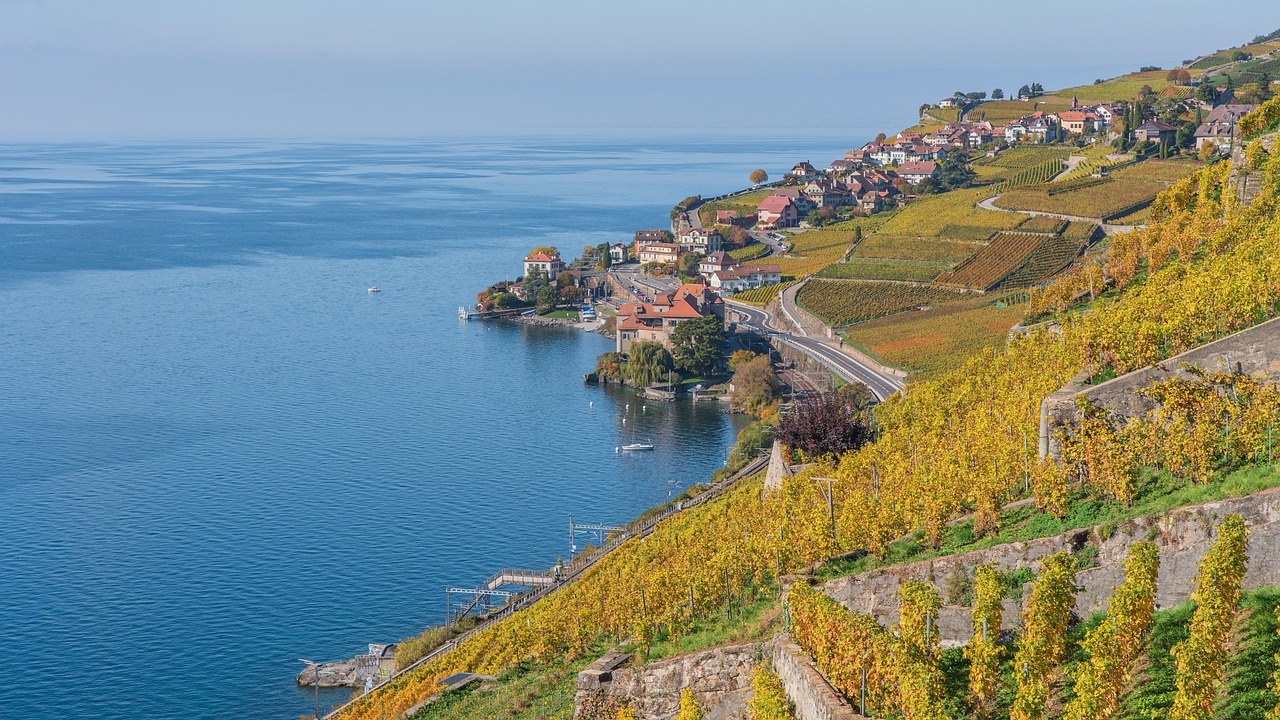
- Chasselas is Switzerland's most planted white variety and produces the defining wines of the Vaud (Lavaux, La Côte) and parts of the Valais. Almost no Chasselas is exported — which is why it remains largely unknown internationally.
- The hallmark of good Chasselas: delicacy and mineral precision, not power. The wines are light-bodied, subtly yeasty, often with a faint natural spritz, and built for food rather than solo drinking. They are not 'impressive' wines — they are quietly excellent ones.
- Lavaux's UNESCO-listed terraced vineyards produce the most distinguished Chasselas, particularly from the named villages of Épesses, Saint-Saphorin, Rivaz, and Dezaley. The steep lakeside slopes produce wines of real mineral character and complexity.
- Chasselas is Switzerland's ultimate food wine. Its low alcohol, high acidity, and neutral character make it the perfect pairing for fondue, raclette, freshwater fish, and the full range of Swiss cuisine.
Chasselas is Switzerland's most important white grape and one of wine's great curiosities: a variety of genuine quality that remains almost entirely unknown outside its country of origin, not because it fails to compete internationally but because virtually none of it is exported. The Swiss drink it themselves, and they do so with good reason.
Understanding Chasselas is understanding something fundamental about Swiss wine culture: a preference for wines that serve food rather than compete with it, that express place rather than grape character, and that are drunk for pleasure rather than as a performance of connoisseurship.
The grape's character
Chasselas is neutral in aroma — significantly more so than Chardonnay, Sauvignon Blanc, or Riesling. This is not a weakness; it is a characteristic. The grape is a vehicle for terroir expression: its neutrality allows the soil, the aspect, the altitude, and the lake's moderating influence to speak through the wine rather than being submerged by dominant varietal character.
Good Chasselas is light-bodied (typically 11–12.5% alcohol), high in acidity, and often shows a subtle natural effervescence — a faint prickle on the tongue — that comes from residual CO₂ retained during a gentle winemaking process. The aromas are understated: white flowers, lemon, a light yeasty note, and — in the best expressions — a distinctive mineral quality that reflects the specific soil beneath the vines.
Lavaux: the benchmark
Lavaux — the terraced vineyards stretching from Lausanne to Vevey along the northern shore of Lake Geneva — is UNESCO-listed, and deservedly. The south-facing terraces, built over centuries by monastic winemakers, capture direct sunlight, reflections from the lake, and warmth from the stone walls at night. The result is a microclimate that allows Chasselas to ripen with unusual consistency in a region that is otherwise marginal for viticulture.
Within Lavaux, the individual village wines have distinct characters: Épesses is considered elegant and floral; Saint-Saphorin earthy and mineral; Rivaz structured and age-worthy; Dezaley — the appellation's most prestigious — full-bodied, complex, and capable of aging three to seven years. The Dezaley grand cru, produced from steep terraced sites above the lake, is the finest expression of Chasselas produced in Switzerland.
Other Swiss Chasselas regions
La Côte, between Lausanne and Geneva, produces a larger volume of Chasselas at slightly lower altitude — wines that are typically lighter and more immediately accessible than Lavaux expressions, and among Switzerland's best value whites.
The Valais produces Chasselas under the local name Fendant — fuller-bodied, with a richer, more textural character than the Vaud expressions. Fendant has historically been the default wine of Swiss restaurants and is inseparable from the fondue tradition. It is not as fashionable as it once was, but quality producers in Sion and Sierre still make excellent examples.
Outside Switzerland, Chasselas appears in Alsace (where it is mostly used in blends), Baden in Germany (as Gutedel, used primarily for everyday drinking), and in small quantities in Hungary and Portugal. Nowhere else treats it as a serious fine wine variety — that remains Switzerland's distinction.
Food pairing
Chasselas is the Swiss food wine par excellence. Its moderate acidity, low alcohol, and neutral character make it a natural partner for fondue (where the wine's crisp acidity cuts through the richness of the melted cheese) and raclette. It pairs with freshwater fish — trout, perch, féra from Lake Geneva — with the quiet precision that a more aromatic white would disrupt. It handles lake fish ceviche, fresh goat's cheese, and delicate vegetable preparations with equal ease.
The best Chasselas is not a wine for reflection in isolation — it is a wine that comes alive with a table full of food and conversation. This is not a limitation; it is its nature.
Tell the sommelier what you're eating — get a Swiss wine recommendation.
Questions we get asked
Why is Chasselas not better known internationally?
Almost none of it is exported. Switzerland produces relatively small quantities, domestic demand is high, and Chasselas does not travel particularly well — it is best drunk young and local. This makes Chasselas one of the few genuinely regional wines left in Europe: to drink it properly, you essentially have to be in Switzerland.
What does Chasselas taste like?
Good Chasselas is light-bodied and subtly aromatic — white flowers, lemon, a light yeasty note — with high acidity and a clean, mineral finish. It is not a wine that announces itself loudly. The pleasure is in its restraint and its partnership with food.
What is the best Chasselas from Switzerland?
The most prestigious expressions come from Lavaux's grand cru appellations — Dezaley and Calamin. Within the broader Lavaux area, Saint-Saphorin, Epesses, and Rivaz produce wines of consistent quality. For everyday Chasselas, a Vaud village wine from a reputable producer is excellent value.
What does Chasselas pair with?
Chasselas is the definitive partner for fondue — its acidity cuts through the melted cheese in a way that no other wine manages as cleanly. It is equally good with raclette, lake fish (perch, pike-perch), charcuterie, and the lighter Swiss dishes that dominate the domestic table. Its versatility is its defining characteristic.